Elsa Margarita Ramírez Leyva (coord.). Arquitectura y ambientes de bibliotecas. México: Universidad Nacional Autónoma de México, Universidad Nacional Autónoma de México. Dirección General de Bibliotecas de la UNAM, 2020
Primer Coloquio Internacional sobre Arquitectura y Ambientes de Bibliotecas, 2 al 4 de Mayo, 2018 Universidad Nacional Autónoma de México, México Objetivo: Intercambiar conocimientos y experiencias multidisciplinarias en la planeación, proyección, diseño, construcción y evaluación de espacios físicos y virtuales en el campo de las bibliotecas universitarias y otras afines, tales como de investigación y especializadas, con la finalidad de establecer líneas de acción y políticas en beneficio de la oferta de servicios y productos de información y bibliotecarios de calidad en tres ambientes: enseñanza-aprendizaje, investigación y lectura.
Antonio L. Galán Gall, Inés María Alamo Fuentes, Margarita Becedas González,.. et al. Manuscritos bibliográficos en la red de bibliotecas universitarias (REBIUN). Ediciones de la Universidad de Castilla-La Mancha, 2021
Este catálogo da noticia de quinientos cincuenta manuscritos de interés bibliográfico conservados en 10 bibliotecas universitarias españolas y centros del CSIC. Fuente imprescindible para la investigación en la formación de las colecciones universitarias, así como en las diferentes situaciones, algunas trágicas, que les han afectado, son estos manuscritos en su mayoría índices, inventarios, listas de lotes fundacionales, donaciones, legados o compras, e inventarios de bibliotecas particulares, que permiten estudiar y profundizar en la historia de las bibliotecas.
Desde el Grupo de Patrimonio de REBIUN invitamos a bibliógrafos, investigadores y estudiantes a utilizar este recurso con la convicción de que servirá de estímulo para desvelar, en futuro quizás no muy lejano, fuentes documentales y bibliográficas inéditas, que permitan escribir nuevas páginas de la historia de las bibliotecas españolas.
Este documento ayuda a que el contenido web, incluidas las aplicaciones, satisfaga las necesidades de las personas con discapacidades cognitivas y de aprendizaje. Cubre metas y objetivos para contenido utilizable; diseñar patrones (formas) para hacer que el contenido sea utilizable; incluir usuarios en actividades de investigación, diseño y pruebas; personas; y necesidades de los usuarios. El documento proporciona una «guía complementaria» informativa más allá de los requisitos de WCAG 2. No es necesario para cumplir con las WCAG.
Este documento tiene contenido sobre:
personas con discapacidades cognitivas y de aprendizaje,
fines y objetivos del contenido utilizable,
patrones de diseño (formas) para hacer que el contenido sea utilizable,
incluyendo a los usuarios en las actividades de diseño y prueba, y
personas (ejemplos) y necesidades de los usuarios.
Los objetivos y patrones presentados aquí proporcionan una guía adicional más allá de los requisitos de las Pautas de accesibilidad al contenido web WCAG [ WCAG22 ].
El tiempo es una magnitud física que permite ordenar la secuencia de los sucesos, estableciendo un pasado, un presente y un futuro, y cuya unidad en el sistema internacional es el segundo. En esta ocasión dedicamos nuestro programa a algunas de las canciones que hablan sobre el tiempo
El presente artículo presenta algunas reflexiones en torno a la forma en que políticas y programas sociales emplean o toman como recurso la investigación en ciencias sociales, con el objetivo de señalar ciertos puntos conjuntivos y horizontes de investigación posibles. Al pensar sobre este nexo entre investigación y política, es necesario pensar también en el debate interno de la producción de conocimiento, como una forma de política. Si bien las lógicas y dinámicas de cada campo (el científico y el político) representan dificultades para dicho nexo (tiempos, procedimientos, formas de comunicabilidad, etc.), esta inmanencia política de la investigación social, que muchas veces parece ser olvidada por la propia comunidad de cientistas, la coloca en continuo conflicto con su campo y con otros campos -como el político- puesto que lo que está en juego es la legitimidad de una visión del mundo social.
En nuestra biblioteca hacía ya tiempo que veníamos dándole vueltas a la creación de alguna actividad que integrara el juego como parte de un aprendizaje lúdico en el ámbito bibliotecario. Hace más de 2 años se presentó la posibilidad de diseñar una actividad como taller para las Jornadas Sociosanitarias que realiza anualmente la Facultad de Enfermería, Fisioterapia y Podología con motivo de su patrón.
En ese momento, junto con el profesor Luis Iván Mayor Silva, con el que solemos colaborar en distintos proyectos, diseñamos una actividad que permitía a un grupo de estudiantes participar en una experiencia que les aportara conocimientos, no sólo del campo bibliotecario (referencias bibliográficas, manejo del buscador CISNE, localización de documentos, etc.) sino también cultural dentro del contexto universitario, incluyendo preguntas sobre el patrimonio de la Universidad Complutense de Madrid, la accesibilidad de sus instalaciones o cuestiones de género.
El resultado fue el nacimiento en 2019 de nuestra “Game Experience”.
El taller consistió en una yincana por equipos, en la que los participantes debían realizar una serie de pruebas y obtener respuestas a las preguntas planteadas; de este modo, los estudiantes tomaban conciencia de algunas realidades como: el escaso número de aulas/salas con nombre de mujer, la dificultad en la accesibilidad en algunas situaciones, el desconocimiento que tenían sobre elementos artísticos que veían a diario, o la importancia de la biblioteca como servicio universitario. Además, como componente sociosanitario, un miembro de cada equipo llevaba los ojos vendados, lo que dificultaba la realización de algunas pruebas.
Por último, se realizó una dinámica de grupo dirigida por el profesor, donde los estudiantes pusieron en común la experiencia y empatizaron con la situación de una persona ciega en un contexto lúdico y el desigual comportamiento del grupo frente a ella.
Al terminar se realizó la entrega de un premio al equipo ganador y nos despedimos hasta el próximo año (¡o hasta su próxima visita a la biblioteca!).
¿Y en 2021? ¿cómo hemos adaptado la Game Experience frente a la COVID?
La crisis sanitaria nos ha obligado a reinventarnos en todos los ámbitos, y nuestra “Game Experience” no iba a ser menos. Así que, tras la decisión de volver a realizarla por tercer año consecutivo, nos pusimos manos a la obra para readaptarla a la situación actual.
En primer lugar, nos vimos obligados a reducir el número de participantes, de modo que pudieran mantenerse las medidas de seguridad y facilitar las labores organizativas de su desarrollo.
Además, se nos ocurrió que no había mejor forma de mejorar la seguridad de los participantes que dotarles del máximo de componentes de protección (mascarillas, guantes, calzas, gorros, etc.), con los que tendrán que enfrentarse en su futuro desarrollo profesional. Y para complicarlo un poco más, un miembro del equipo debía realizar las pruebas llevando puesto un EPI sanitario completo.
La actividad se diseñó con la participación de un enfermero del Hospital Zendal (¡Gracias, Samir!) que les transmitiría su experiencia y explicaría de primera mano el protocolo de colocación y retirada del equipo (aunque a última hora se canceló su participación por un posible positivo). En su lugar, se visionaron dos vídeos explicativos y se supervisó la correcta colocación, que contabilizó como una prueba más en la actividad.
Para esta edición realizamos también cambios en algunas ubicaciones en las que se desarrollaban las pruebas, introduciendo una visita a la Biblioteca María Zambrano que permitió conocer este espacio a algunos de los participantes y se incluyo un mayor número de pruebas en exteriores.
En esta ocasión las dinámicas de grupo arrojaron reflexiones como la dificultad de realizar actividades con un equipo de protección individual, o los sentimientos ante las reacciones del resto de estudiantes al verlos aparecer con su futura indumentaria de trabajo.
Tras estas tres ediciones, la Game Experience se ha consolidado como una actividad dentro del programa habitual de las Jornadas, permitiendo a la biblioteca colaborar de forma activa en la celebración de uno de los días más importantes de la Facultad. De este modo, contribuimos a cambiar la perspectiva de algunos estudiantes sobre nuestros servicios y profesionales, dando a conocer espacios, servicios y patrimonio de la UCM, al tiempo que colaboramos en su desarrollo profesional y personal. Y por encima de todo, pasan un buen rato con nosotros.
La revista Ecosystem Health and Sustainability (EHS) cuenta con una envidiable lista de científicos de alto nivel en su consejo editorial, entre los que se encuentran el conocido biólogo Paul Ehrlich, profesor emérito de la Universidad de Stanford, y Jerry Franklin, analista de ecosistemas de la Universidad de Washington, en Seattle.
Sólo hay un problema: muchos de los miembros del consejo ya no participan en EHS, si es que alguna vez lo hicieron. «No recuerdo ningún contacto con la revista desde hace años, si es que alguna vez lo hubo», dice Ehrlich. «No debería aparecer como asociado a la revista», añade Franklin.
Este tipo de relleno puede hacer que una revista parezca más prestigiosa de lo que es, y ayudarla a obtener un factor de impacto, crucial para atraer propuestas.
La práctica parece ser mucho menos común entre las revistas más respetables como EHS, pero no es inédita. El redactor jefe de EHS, Lu Yonglong, ecologista de la Universidad de Xiamen, afirma que es «realmente una sorpresa para mí» que varios científicos se resistan a figurar como miembros del consejo editorial. Dice que la revista les ha informado regularmente de la situación de EHS, proporcionando una lista de nueve correos electrónicos enviados en los últimos 18 meses a todos los que figuran como asesores y editores. Pero Lu admite que el sitio web de EHS «puede no actualizarse con frecuencia» y dice que eliminará los nombres de los científicos que se lo pidan.
No es raro que las llamadas revistas depredadoras recluten científicos como miembros de la junta sin su conocimiento. Un estudio publicado el año pasado encontró que de los casi 4000 científicos en Australia que están en los consejos editoriales de revistas potencialmente depredadoras, aproximadamente una cuarta parte no lo sabe. Para exponer tales revistas, un científico inscribió a su perro, un American Staffordshire terrier llamado Ollie, como miembro de la junta editorial de seis revistas.
Recientemente, Johannes Knops, de la Universidad de Xi’an Jiaotong-Liverpool en Suzhou, China, fue eliminado como «miembro editorial» de la revista Sciences in Cold and Arid Regions ; dice que nunca estuvo de acuerdo con el trabajo. “Solía decirles a los estudiantes que miraran a los editores revisores para conocer la calidad de una revista”, dice Knops. Pero ahora, «tienes que ponerte en contacto con algunos editores para ver si son reales». (Los editores de la revista no respondieron a un correo electrónico de Science ).
Tener en el comité a científicos de alto nivel puede aumentar las probabilidades de que una revista sea incluida en el Science Citation Index Expanded de Clarivate, lo que supone un paso hacia la obtención de un factor de impacto. Hacerlo sin su consentimiento «raya en lo depredador», dice Xiaotian Chen, profesor de biblioteconomía de la Universidad de Bradley en Peoria (Illinois).
Las competencias digitales constituyen una habilidad esencial para participar en un mundo impulsado por la tecnología. Al mismo tiempo, las competencias digitales son un área con lagunas de investigación, y datos insuficientes. El Estudio Internacional de Alfabetización Informática y de la Información (ICILS) pretende colmar estas lagunas estudiando en qué medida los jóvenes son capaces de utilizar las tecnologías de la información y la comunicación (TIC) de forma productiva en la escuela, en casa, en la sociedad y en sus futuros lugares de trabajo.
Carretero Gomez, S., Punie, Y., Vuorikari, R., Cabrera Giraldez, M. and Okeeffe, W., editor(s), Kluzer, S. and Pujol Priego, L., DigComp into Action: Get inspired, make it happen. A user guide to the European Digital Competence Framework, EUR 29115 EN, Publications Office of the European Union, Luxembourg, 2018, ISBN 978-92-79-79901-3, doi:10.2760/112945, JRC110624.
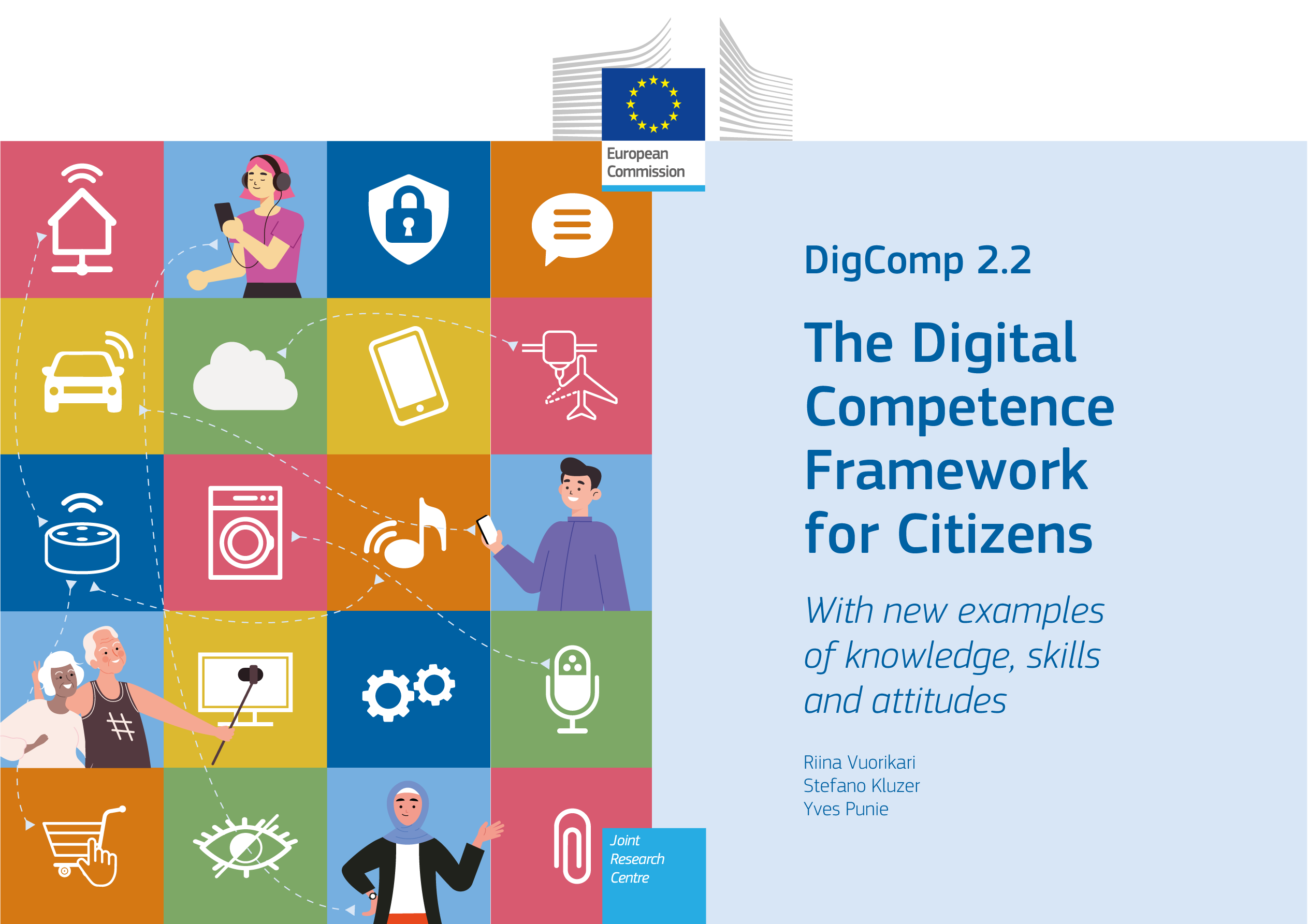
El Marco Europeo de Competencias Digitales para los Ciudadanos (DIGCOMP) tiene como objetivo la formación de profesionales en sintonía con las necesidades de la sociedad contemporánea. El marco proporciona la descripción detallada de todas las habilidades necesarias para ser competente en entornos digitales y las describe en términos de conocimientos, habilidades y actitudes y aporta los niveles dentro de cada competencia. Estableciendo 21 competencias en cinco áreas (Comisión Europea, 2016).
Creación de contenido digital
Comunicación y colaboración
Información y tratamiento de datos
Seguridad
Resolución de problemas
Con dos tipos de competencias: 10 competencias técnicas y 10 transversales. Entre las competencias técnicas. Enumera las siguientes:
Inteligencia artificial
Redes de comunicaciones
Impresión 3D
Diseño electrónico
Programación de realidad virtual
Robótica
Automatización industrial
Programación de microcontroladores
Diseño asistido por ordenador (CAD)
Técnicas de diseño sostenible
Y entre las competencias transversales:
Creatividad
Resiliencia
Responsabilidad en el cumplimiento de normas y tareas
Las Directrices Internacionales sobre Desarrollo de Habilidades Informativas han sido compiladas por la Sección de Alfabetización Informativa (InfoLit), de la Federación Internacional de Asociaciones e Instituciones Bibliotecarias (IFLA), con el propósito de proporcionar una marco de referencia pragmático para aquellos profesionales de la información que necesitan o están interesados en iniciar o reforzar un programa de desarrollo de habilidades informativas (DHI). Las directrices son útiles para profesionales de la información que trabajan en programas para el desarrollo de competencias informativas de educación básica y educación superior en sus esfuerzos por cubrir sus necesidades actuales de información.. Sin embargo, la mayoría de los conceptos, principios y procedimientos de estas directrices pueden ser aplicados, a cualquier tipo de bibliotecas, con solo adaptaciones mínimas. Los profesionales de la información que trabajan en bibliotecas deben tener como uno de sus principales objetivos institucionales el fomento y facilitación de la adquisición de competencias informativas por parte de sus usuarios. Las habilidades de la información son vitales para el éxito del aprendizaje permanente, el empleo y la comunicación interpersonal cotidiana de cualquier ciudadano, desde una persona que necesita información sobre servicios de salud para alguien a su cuidado, hasta un estudiante que requiere información específica para completar una tarea escolar.
Las Directrices Internacionales sobre Desarrollo de Habilidades Informativas han sido compiladas por la Sección de Alfabetización Informativa (InfoLit), de la Federación Internacional de Asociaciones e Instituciones Bibliotecarias (IFLA), con el propósito de proporcionar una marco de referencia pragmático para aquellos profesionales de la información que necesitan o están interesados en iniciar o reforzar un programa de desarrollo de habilidades informativas (DHI). Las directrices son útiles para profesionales de la información que trabajan en programas para el desarrollo de competencias informativas de educación básica y educación superior en sus esfuerzos por cubrir sus necesidades actuales de información.. Sin embargo, la mayoría de los conceptos, principios y procedimientos de estas directrices pueden ser aplicados, a cualquier tipo de bibliotecas, con solo adaptaciones mínimas. Los profesionales de la información que trabajan en bibliotecas deben tener como uno de sus principales objetivos institucionales el fomento y facilitación de la adquisición de competencias informativas por parte de sus usuarios. Las habilidades de la información son vitales para el éxito del aprendizaje permanente, el empleo y la comunicación interpersonal cotidiana de cualquier ciudadano, desde una persona que necesita información sobre servicios de salud para alguien a su cuidado, hasta un estudiante que requiere información específica para completar una tarea escolar.
Normas sobre aptitudes para el acceso y uso de la información en la educación superior (Aprobadas por la ACRL/ALA el 18 de enero de 2000. Traducción al castellano por Cristóbal Pasadas Ureña, Biblioteca, Facultad de Psicología, Universidad de Granada; revisión por el Grupo de Bibliotecas Universitarias de la Asociación Andaluza de Bibliotecarios; versión en castellano publicada por acuerdo entre la ACRL/ALA y la AAB. Disponible en formato electrónico en http://www.aab.es). Se entiende por aptitudes para el acceso y uso de la información un conjunto de habilidades que exigen a los individuos ‘reconocer cuándo se necesita información y poseer la capacidad de localizar, evaluar y utilizar eficazmente la información requerida’. Las aptitudes para el acceso y uso de la información resultan cada vez más importantes en el entorno actual de rápidos cambios tecnológicos y de proliferación de los recursos de información. A causa de la complejidad cada vez mayor de este entorno, los individuos se enfrentan a diversas alternativas a la hora de elegir entre una información muy dispar y abundante – en sus estudios universitarios, en su puesto de trabajo y en su vida privada.
Learning in the 21P stP Century has taken on new dimensions with the exponential expansion of information, ever-changing tools, increasing digitization of text, and heightened demands for critical and creative thinking, communication, and collaborative problem solving. To succeed in our rapid-paced, global society, our learners must develop a high level of skills, attitudes and responsibilities. All learners must be able to access high-quality information from diverse perspectives, make sense of it to draw their own conclusions or create new knowledge, and share their knowledge with others. In recognition of these demands, the American Association of School Librarians has developed standards for the literacy, technology, critical thinking, and information skills that all learners need to acquire. The new standards, entitled Standards for the 21PstP-Century Learner, take a fresh approach and a broad perspective on student standards in the school library field by focusing on the learning process, not on the more limited concept of information literacy. These standards lay out underlying common beliefs as well as standards and indicators for essential skills, dispositions, responsibilities, and self-assessment strategies for all learners. These standards represent high expectations for today’s learners, because they will provide the foundation for learning throughout life. The standards and indicators will serve as guideposts for school library media specialists and other educators in their teaching, because these skills and dispositions are most effectively taught as an integral part of content learning.
Published by the American Association of School Librarians (AASL) and Britannica Digital Learning, A Planning Guide for Empowering Learners is an online program assessment and planning module for school libraries. This interactive tool saves and converts user entries into worksheets, charts and graphs, saving librarians time while delivering data to schools and districts. Subscribers can login to the module at http://aasl.eb.com. Comprehensive assessment is the foundation for successful planning. The cornerstone within the module is the School Library Program Assessment Rubric, a tool that allows school librarians to assess their program on 16 different sets of criteria, or 65 individual criteria. Data entered is processed into colorful top-level summary charts and graphs that school librarians can share with stakeholders, colleagues and supervisors when discussing library program health, or saved and archived year-to-year to determine progress comparisons. Program improvement being a continuous process, the School Library Program Assessment Rubric presents an entry point for establishing goals for each cycle. Using findings from the rubric, the planning section of the module follows a series of sequential steps that ensure users go beyond the basics of planning and reporting. Designed to allow for flexibility and encourage collaboration, the planning process walks users through evaluating the existing program, involving stakeholders in the planning process, aligning the library program mission with that of the school or district, developing action plans based on assessment data, setting ambitious but measurable and attainable goals and objectives, and charting implementation progress and results. School librarians can access the module online from any computer, save and edit their program plans and monitor their progress.
Alan Bubdie, A. «El marco para la alfabetización informacional en Australia y Nueva Zelanda. Principios, normas y práctica.»Congreso internacional de AEDEAN vol., n. 27 (2003). pp.: http://www.aab.es/pdfs/baab73/73a4.pdf
Con el fin de reflejar la forma en que profesores y bibliotecarios han utilizado la primera edición. Se incorporan cambios desarrollados durante un taller de trabajo en Sydney en enero de 2003. Antes del taller se recibieron aportaciones de bibliotecarios de bibliotecas universitarias, especializadas y otras de Australia y Nueva Zelanda. Más de cincuenta profesores y bibliotecarios que habían trabajado con la primera edición aportaron sus experiencias. Dos grupos reducidos trabajaron en cada norma y las ideas desarrolladas. Un nuevo grupo evaluó los materiales, y un panel representativo del taller volvió a revisar la penúltima versión. Esta edición es, por tanto, consistente con la primera, pero beneficiándose de las aportaciones basadas en la experiencia tras su utilización y en el largo proceso de revisión por colegas. Habida cuenta del cuidado con que se ha llevado a cabo el proceso de revisión de las normas, puede estar justificado el aumento de confianza en su uso, especialmente dentro del sector de la educación terciaria
(Aprobadas por la ACRL/ALA el 18 de enero de 2000. Traducción al castellano por Cristóbal Pasadas Ureña, Biblioteca, Facultad de Psicología, Universidad de Granada; revisión por el Grupo de Bibliotecas Universitarias de la Asociación Andaluza de Bibliotecarios; versión en castellano publicada por acuerdo entre la ACRL/ALA y la AAB. Disponible en formato electrónico en http://www.aab.es)
Objective – This study investigates the information literacy of graduate education students, including those in doctoral cohorts. The Association for Research and College Libraries Information Literacy Standards were used a baseline for measurement. Methods – A survey was sent to all graduate students in the School of Education; it asked a combination of questions measuring students’ perceptions of their information literacy skills and testing their knowledge of information literacy. Results – A total of 172 surveys were returned. The results indicated that while there is a heavy reliance on internet sources, many students were able to determine which sources were reliable and which were not. After attending information instruction sessions, students were more familiar with library services and more inclined to use them. Conclusion – It was determined that a one credit course or multiple sessions of library instruction would better serve graduate students completing capstone projects.
Se presenta una propuesta de aplicación de la metodología del enfoque de competencias laborales a la construcción de las normas técnicas de competencia en el ámbito de la información. Se repasan, en primer lugar, los conceptos de alfabetización informativa, competencia y normalización para pasar a proponer, a continuación, una metodología que permita elaborar normas técnicas de competencia en información. Se aporta también un ejemplo práctico de aplicación de esta metodología a una competencia en concreto (la búsqueda de información).
Anziil «El marco para la alfabetización informacional en Australia y Nueva Zelanda. Principios, normas y práctica.»Boletín de la Asociación Andaluza de Bibliotecarios vol. 18, n. 73 (2003). pp. 109-120. http://www.aab.es/pdfs/baab73/73a4.pdf
Esta segunda edición de las Normas sobre Alfabetización Informacional 2001 se denomina Marco para la alfabetizacion informacional en Australia y Nueva Zelanda: principios, normas y práctica, con el fin de reflejar la forma en que profesores y bibliotecarios han utilizado la primera edición. Se incorporan cambios desarrollados durante un taller de trabajo en Sydney en enero de 2003. Antes del taller se recibieron aportaciones de bibliotecarios de bibliotecas universitarias, especializadas y otras de Australia y Nueva Zelanda. Más de cincuenta profesores y bibliotecarios que habían trabajado con la primera edición aportaron sus experiencias.
Anziil «Australian and New Zealand Information Literacy Framework principles, standards and practice.»Australian and New Zealand Institute for Information Literacy vol., n. (2004). pp.: http://www.anziil.org/resources/Info%20lit%202nd%20edition.pdf
This second edition of the 2001 Information literacy standards is entitled the Australian and New Zealand information literacy framework: principles, standards and practice to reflect the ways academics and librarians have used the first edition. It incorporates changes developed at a workshop in Sydney in January 2003. Prior to the workshop, input was received from university, technical and further education and other librarians from around Australia and New Zealand. More than fifty academics and librarians who had used the first edition contributed their experience. Two small groups worked on each standard, and the ideas developed were peer reviewed by a third group. A steering group evaluated this material, and a representative panel from the workshop reviewed the penultimate version. This edition is thus consistent with the first edition, but benefits from input based on experience in use, and peer review. Given the care with which the standards have been revised, there can be increased confidence in their use, especially in the tertiary education sector.
Information literacy is a set of abilities requiring individuals to “recognize when information is needed and have the ability to locate, evaluate, and use effectively the needed information.”1 Information literacy also is increasingly important in the contemporary environment of rapid technological change and proliferating information resources. Because of the escalating complexity of this environment, individuals are faced with diverse, abundant information choices—in their academic studies, in the workplace, and in their personal lives. Information is available through libraries, community resources, special interest organizations, media, and the Internet—and increasingly, information comes to individuals in unfiltered formats, raising questions about its authenticity, validity, and reliability. In addition, information is available through multiple media, including graphical, aural, and textual, and these pose new challenges for individuals in evaluating and understanding it. The uncertain quality and expanding quantity of information pose large challenges for society. The sheer abundance of information will not in itself create a more informed citizenry without a complementary cluster of abilities necessary to use information effectively.
Academic librarians should expand our understanding of what counts as an authoritative resource, and be unafraid to challenge long-established wisdom in this domain. Wikipedia is far from perfect, but neither is the Encyclopedia Britannica. Wikipedia is updated daily, while the Britannica is no longer printed. If we cling to the Britannica as a symbol of authoritativeness, we will become obsolete ourselves. One way to prevent this fate is to reframe our collective thinking. In 2014 the Association of College and Research Libraries (ACRL) will issue a revised version of the Information Literacy Competency Standards for Higher Education. The task force shepherding this revision (ACRL, 2012) argues that the standards “should not be reapproved as they exist but should be extensively revised” (pg. 1). This is because the Internet has profoundly altered the ways in which we create, share, analyze and validate information. To be credible, the new ACRL standards must take full account of this change.
In 2011, the ACRL Science & Technology Section (STS) completed its five-year review of the Information Literacy Standards for Science and Engineering/Technology. Predicated by the evolving nature of scholarship and research in the sciences, the reviewing task force strongly recommended that the standards be revised. This paper considers the broad recommendations of the task force, using the framework of e-Science – team-based, data-driven science – to address areas of necessary transformation in information literacy: an advanced team-based model that crosses disciplinary boundaries; a recognition that individuals and groups not only consume information, but also produce it; and stronger interplay between information literacy and complementary literacies. This paper also extrapolates beyond the sciences, referencing broader trends within higher education.
Purpose – This paper aims to provide an overview of issues relevant to scientific information literacy within the context of the remote sensing, a cross-cutting scientific discipline. The authors examine the range of sources of scientific information, trends in publishing and the characteristics of scholarly articles in the field of remote sensing. They focus on challenges in finding and using information, as well as current trends and emerging issues. Design/methodology/approach – Issues pertinent to teaching information literacy and particularly remote sensing research and lifelong learning are reviewed, drawing on the knowledge and experience of the authors, as well as published resources. Findings – The large and increasing volume of publications in remote sensing suggests that professionals in this field require a contextual understanding of knowledge production and dissemination in remote sensing, as well as specific literature search skills. Research limitations/implications – Just as for the field of remote sensing, scientific knowledge dissemination is changing rapidly. The full implications of electronic publications have probably not yet been realized in remote sensing, but have already changed the landscape considerably. In particular, open-access publications may have significant implications for both scholars and libraries. Practical implications – This paper will be useful to information professionals, including librarians, who will benefit from a deeper understanding of remote sensing literature and how remote sensing information is produced, stored and disseminated. This knowledge is essential for teaching remote sensing students advanced information literacy skills. Originality/value – Librarians, as well as educators and professionals in the field of remote sensing, require information on the context of remote sensing knowledge production and dissemination as a key component of information literacy. A review of the literature did not reveal current treatment of information literacy in the field of remote sensing.
Blevens, C. L. «Catching up with information literacy assessment Resources for program evaluation.»College & Research Libraries News vol. 73, n. 4 (2012). pp. 202-206. http://crln.acrl.org/content/73/4/202
The goal of this article is to build on the assessment links Jarson provided. Her stated goal was to “guide readers to important resources for understanding information literacy and to provide tools for readers to advocate for information literacy’s place in higher education curricula.” In addition to the information on resources and tools, Jarson provided links to universities whose assessment tools were available for review on their Web sites. For this article, selected Web sites have been accessed and evaluated further. A handful of additional information resources have been profiled, including new Web sites that offer a variety of assessment tool formats.
These guidelines are intended to be advisory, not prescriptive. Workshop coordinators, and their respective host institutions, may need to modify the guidelines in some minor respects in order to customize them to their own unique circumstances. However, major revisions should be negotiated and agreed to in advance with the project principals, including UNESCO. Most minor changes will normally be acceptable, so long as the thrust of the main policy, procedures and responsibilities are retained, including financial arrangements, and prior approval is secured. These Guidelines are organized along the following lines: 1. Background of the Regional Workshop Series; 2. The UNESCO Project Proposal; 3. Roles of Workshop Coordinators and the Workshop Host Institutions; 4. Planning the Workshop Format and Content; and 5. Logistical and Financial Arrangements. There are also several appendices containing more detailed and technical materials, including a model participant application form which may be modified by host workshop institutions to suit their own particular needs.
Purpose ? The purpose of this study is to examine how guidelines for information literacy and library instruction can be incorporated into online research guides and provide examples from guides that have done this. Design/methodology/approach ? Online research guides in forestry were identified and examined using the ACRL’s ?Information literacy competency standards for higher education? and guidelines for library instruction set forth in LaGuardia and Oka’s Becoming a Library Teacher. Findings ? While some research guides simply provide unannotated links to online resources, others seek to engage the user by incorporating features that correspond directly to elements of a library instruction session. Originality/value ? The study presents practical ways in which online research guides can serve as library instruction tools.
Bundy, A. (2004). [e-Book] Australian and New Zealand Information Literacy Framework: principles, standards and practice. Adelaide, Australian and New Zealand Institute for Information Literacy. Texto completo: http://www.library.unisa.edu.au/learn/infolit/Infolit-2nd-edition.pdf
This second edition of the 2001 Information literacy standards is entitled the Australian and New Zealand information literacy framework: principles, standards and practice to reflect the ways academics and librarians have used the first edition. It incorporates changes developed at a workshop in Sydney in January 2003. Prior to the workshop, input was received from university, technical and further education and other librarians from around Australia and New Zealand. More than fifty academics and librarians who had used the first edition contributed their experience. Two small groups worked on each standard, and the ideas developed were peer reviewed by a third group. A steering group evaluated this material, and a representative panel from the workshop reviewed the penultimate version. This edition is thus consistent with the first edition, but benefits from input based on experience in use, and peer review. Given the care with which the standards have been revised, there can be increased confidence in their use, especially in the tertiary education sector.
Abstract: The first PA Forward Information Literacy Summit was held in State College at the Pennsylvania State University, University Park campus, on Wednesday, July 24, 2013. This summit brought together K-12 and academic librarians from Pennsylvania to discuss current issues in information literacy. This text is a transcript of a discussion between Ellysa Cahoy, past chair of the of the ACRL Information Literacy Competency Standards Committee, and the ACRL Information Literacy Competency Standards Review Task Force, and Craig Gibson and Trudi Jacobson who are currently co-chairs of the ACRL Information Literacy Standards Revision Task Force. This Task Force is charged with reviewing and revising the current ACRL Information Literacy Competency Standards for Higher Education, that were originally adopted by ACRL in 2000. This discussion was about the process by which the Standards came to be under review, some of the issues involved in the review, and the time line for the review and librarian feedback and comment on the process. The PowerPoint presentation which accompanied this discussion, as well as other documents mentioned during the presentation are attached to this transcript as supplemental files.
Council of Australian University, L. «Normas sobre alfabetización en información (1ª Edición).»Boletín de la Asociación Andaluza de Bibliotecarios vol. 17, n. 68 (2002). pp.: http://www.aab.es/pdfs/baab68/68a4.pdf
Normas sobre alfabetización en información (1ª Edición) Council of Australian University Librarians (Traducción al castellano por Cristóbal Pasadas Ureña, Biblioteca, Facultad de Psicología, Uni-versidad de Granada; revisión editorial por el Grupo de Bibliotecas Universitarias de la Asociación Andaluza de Bibliotecarios; versión en castellano publicada bajo autorización del Council of Australian University Librarians.
Cuevas Cerveró, A. «Normas de alfabetización en información para el aprendizaje de los estudiantes [i] Normas e Indicadores American Association of School Librarians Association for Educational Communications And Technology.»Boletín de la Asociación Andaluza de Bibliotecarios vol. 21, n. 84-85 (2006). pp. 29-34. http://www.aab.es/pdfs/baab84-85/84-85a2.pdf
Las normas de Alfabetización en Información para el aprendizaje de los estudiantes proporcionan un marco conceptual y unas pautas amplias para describir al estudiante alfabetizado en información. Comprenden tres categorías, nueve normas y veintinueve indicadores. El núcleo de los resultados de aprendizaje más directamente relacionados con los programas proporcionados por la biblioteca escolar se fundamenta en tres normas y trece indicadores en la categoría “Alfabetización en Información”.
Purpose The purpose of the study was to establish the relations between two important roles of school library media (SLM) specialists: cooperation with teachers and provision of information literacy programs to students. Methodology One-hundred thirty eight library media specialists employed in Israeli high schools replied to several questionnaires developed specifically for this study. Factor analysis extracted three factors for collaboration with teachers (provision of learning resources, expertise in digital information and curriculum planning) and three factors for librarians’ educational role in the provision of information literacy to students (teaching information literacy skills, fostering independent learning skills and conveying ethical standards for information use). Additional statistical tests were used to determine the extent of SLM specialists’ involvement in the different roles and the correlations between the various factors. The study examined also the impact of background characteristics on librarians’ educational roles. Findings The results indicate that an ongoing relation with teachers, particularly in the provision of information resources, is highly correlated with the teaching of information literacy programs to students. Advanced technology in the school library media centre facilitates higher-level cooperation with teachers as well as higher involvement in information literacy educational programmes. Practical Implications The study shows that information literacy programs benefit from the collaboration between librarians and teachers. The statistical analyses indicate which aspects of librarians’ roles should be expanded in order to facilitate cooperation with teachers and elevate librarians’ involvement in information literacy programmes. Originality Unlike previous studies, this paper addresses directly the relationship between collaboration with teachers and provision of information literacy programmes, and its conclusions contribute to the generalization of previous findings. This is the first study of Israeli school librarians’ practice of educational roles.
Dunna, K. «Assessing information literacy skills in the California state university: a progress report.»Journal of Academic Librarianship vol. 28, n. 1-2 (2002). pp.: http://www.sciencedirect.com/science/journal/00991333
What do students know about finding, evaluating, and using information? What can we learn about how to evaluate complex constructs presented as information literacy standards or competencies? This article is a progress report on an ongoing, innovative assessment project that aims to discover answers to those questions and many more.
Elmborg, J. «Lessons from Forty Years as a Literacy Educator: An Information Literacy Narrative.»Journal of Information Literacy vol., n. 1 (2017). pp. 54-67%V 11. https://ojs.lboro.ac.uk/JIL/article/view/PRA-V11-I1-2
This article summarises the author’s evolution as a writing instructor toward a career as a librarian teaching information literacy and finally as a scholar and researcher studying information literacy as an academic subject. Changes in writing pedagogy are explored as they relate to changes in the author’s instructional practices and how they underlie an understanding of information literacy as a form of literacy practice closely related to writing. Questions about the future of information literacy under current management philosophy are presented.
Purpose – The purpose of this study is to obtain preliminary evidence over a three-year period on the efficacy of a curriculum designed to foster information literacy skills in graduate students in a chemistry bibliography course. Design/methodology/approach – Specifically, the researchers examined the application and results of an assessment tool and its connectivity to instructional strategies for improving literacy outcomes. ACRL’s ‘Information literacy competency standards for higher education’ provided the basis for the construction of the assessment tool. The instrument was given to chemistry graduate students enrolled in the course at the beginning and at the end of the semester. Findings – The assessment results from all three years indicated marked improvements in the average student score from the pre- to the post-test. The assessment provided evidence of skill development over the course of the semester for specified outcomes. Research limitations/implications – The research would have been strengthened by the use of a valid control group of graduate students in related chemistry majors who were not enrolled in the class. The extended study would have supplied rates of improvement in the control group over a given period of time compared with rates of improvement of students enrolled in the class. Practical implications – The paper provides methods for approaching the assessment of information literacy skills by focusing on tool development based on desired learning outcomes. Originality/value – The study developed, refined and applied a methodology to assess student information literacy skills based on learning outcomes over a three-year period. The literature lacks reports of studies looking at the assessment of information literacy development of graduate students in the sciences as well as the use of ‘backward design’ in creating evaluative tools.
In the United States, the decline in jobs for high school educated workers and the proliferation of jobs for post-secondary educated workers is driving the development of the Common Core State Standards. The Common Core State Standards theoretically shift K-12 pedagogy towards ability development of critical and extended thinking skills, preparing high school graduates for college and career readiness. This literature review explores the reasoning behind the shift to the Common Core State Standards and asks questions regarding the potential ramifications their adoption might have on post-secondary information literacy instruction.
ACRL and other academic librarians are currently re-examining the tough questions of learning, literacy, and education — and the librarians’ role in addressing these issues. They can use AASL’s learning standards as one springboard for thought, particularly in terms of articulating learning. The result is a developmentally appropriate set of standards that reflects lifelong engagement with, and creation of, recorded information.
Gracy, K. F. and J. A. Croft «Quo Vadis, Preservation Education?: A Study of Current Trends and Future Needs in Continuing Education Programs.»Library Resources & Technical Services vol. 51, n. 2 (2007). pp. 81-97.
This research study assesses preservation education offered by continuing education (CE) providers in the United States. Educators teaching preservation workshops for regional field service organizations and other local and regional preservation networks were surveyed about the type and number of workshops offered, content of preservation offerings, audience, faculty resources, future plans for curricula, and availability of continuing education credits. The investigators hypothesize that preservation workshops offered by CE providers serve multiple purposes for the library and archival science professions, becoming not only an avenue for professionals to continue to develop or reinforce their knowledge and skills in preservation, but also often the primary source of rudimentary preservation education for library and information science professionals and paraprofessionals. This paper reviews the literature relevant to the study of preservation in the CE environment, describes the research methodology employed in designing and conducting the survey, presents the resulting data, and analyzes the trends revealed by the data in order to understand more fully the goals and objectives of CE in preservation during the last decade and to gauge future directions of the field. This paper concludes by presenting plans for further research, which will expand upon initial findings of this survey.
The publication of educational standards inspires a variety of responses—from wholesale acceptance and deployment to criticism and blame. The author of this paper contends that the revision of the ACRL’s Information Literacy Competency Standards for Higher Education must be accompanied by a critical, conscious, and conscientious reception by librarians and information literacy advocates.
In 1999, ACRL convened a national task force to draft Information Literacy Competency Standards for Higher Education. ACRL has recently launched a revision to those standards. The original standards were influential because they helped advance a national need in higher education at the time: a shift to outcomes based learning. Fourteen years later, information literacy stands alongside oral and written communication, critical thinking and ethical reasoning as learning outcomes broadly acknowledged as needing to be integrated, with disciplinary content, into the curriculum. This author believes that, in contrast to the first process, the current recommendations for revision are focused on the wrong question and include the wrong people to address it. The point isn’t to further define, redefine and write more, less or different learning outcomes. The challenge now is to move ahead and address the current concerns of education reform: vertical integration with disciplinary knowledge, curriculum mapping, and assessment. There are a host of challenges and libraries and librarians are perfectly poised to help.
Institute for Information, L. «Características de los programas de alfabetización que sirven como ejemplo de las mejores prácticas.»Boletín de la Asociación Andaluza de Bibliotecarios vol. 18, n. 70 (2003). pp.: http://www.aab.es/pdfs/baab70/70a4.PDF
Estas directrices sobre Características de los Programas de Alfabetización en Información que sirven como ejemplo de las mejores prácticas pretenden articular elementos de programas de alfabetización en información ejemplares para estudiantes de pregrado en instituciones de cuatro y dos años. Las características identifican y describen rasgos notables de programas de alfabetización en información excelentes. Pero no son descriptivas de ningún programa concreto; representan más bien un conjunto de elementos identificados por medio del examen de muchos programas y políticas de alfabetización en información para pregrado.
The current “ACRL Information Literacy Competency Standard Review Task Force” presents information literacy practitioners with an engaging intellectual endeavor: how might these standards be revised, rethought, re-envisioned? Regardless of what the review yields, the process is an excellent opportunity for us to think broadly and creatively about the Standards and to remember that they are not a fixed set of rules but a malleable and evolving document. Asking questions about the practical, pedagogical, and theoretical implications of the Standards and considering alternative approaches will yield engaging, fruitful, and necessary conversations not only about the teaching of information literacy but about our role as librarians within the educational mandates of our institutions.
Metaliteracy is envisioned as a comprehensive model for information literacy to advance critical thinking and reflection in social media, open learning settings, and online communities. At this critical time in higher education, an expansion of the original definition of information literacy is required to include the interactive production and sharing of original and repurposed digital materials. Metaliteracy provides an overarching and unifying framework that builds on the core information literacy competencies while addressing the revolutionary changes in how learners communicate, create, and distribute information in participatory environments. Central to the metaliteracy model is a metacognitive component that encourages learners to continuously reflect on their own thinking and literacy development in these fluid and networked spaces. This approach leads to expanded competencies for adapting to the ongoing changes in emerging technologies and for advancing critical thinking and empowerment for producing, connecting, and distributing information as independent and collaborative learners.
Johnson, B. and S. Edward «Reading for Integration, Identifying Complementary Threshold Concepts: The ACRL Framework in Conversation with Naming What We Know: Threshold Concepts of Writing Studies.»Communications in Information Literacy vol. 10, n. 2 (2016). pp. 178-198. http://www.comminfolit.org/index.php?journal=cil&page=article&op=view&path%5B%5D=v10i2p178
In 2015, threshold concepts formed the foundation of two disciplinary documents: the ACRL Framework for Information Literacy (2015) and Naming What We Know: Threshold Concepts of Writing Studies (2015). While there is no consensus in the fields about the value of threshold concepts in teaching, reading the six Frames in the ACRL document alongside the threshold concepts of writing studies illuminates overlapping elements that may empower faculty in both fields to advocate collectively against skills-focused writing and research instruction through cross-disciplinary integrations. To facilitate cross-disciplinary conversations around the documents, the authors propose an order for reading the Frames, identify the associated writing concepts, and explain how the shared concepts reveal an internal complexity which may have implications for teaching the ACRL Framework.
Kimura, S. «Information Literacy Assessment: Standards-Based Tools and Assignments.»Reference & User Services Quarterly vol. 46, n. 4 (2007). pp.:
Information Literacy Assessment: Standards-Based Tools and Assignments.
I propose three “rethinks” to consider in recasting the ACRL Standards for information literacy for the coming decades. First, rethink the concept of information need. Second, rethink the notion that information literacy is composed of a set of abilities for “extracting information.” Third, rethink the holistic process of learning from a variety of sources of information that is central to information literacy. The necessity for these “rethinks” are grounded in my extensive studies of students’ experience in the information search process that reveal an evolving, dynamic, holistic process incorporating a series of feelings (affective), thoughts (cognitive) and actions (physical) as described in the six stage model of the ISP (Kuhlthau, 2004). The challenge is to begin with the premise that information literacy enables a person’s deep thoughtful process of learning from a variety of sources that is essential in a dynamic information environment.Rethinking the 2000 ACRL Standards: Some Things to Consider
Laherty, J. «Promoting Information Literacy for Science Education Programs: Correlating the National Science Education Content Standards with the Association of College and Research Libraries Information Competency Standards for Higher Education.»Issues in Science and Technology Librarianship vol., n. 28 (2000). pp.: http://www.library.ucsb.edu/istl/00-fall/article3.html
Librarians who want to collaborate with faculty to incorporate information literacy into science education programs should understand the theories, pedagogies, and standards that serve the academic discipline. Understanding the National Science Education Standards (NSES) is beneficial for librarians seeking to partner with disciplinary faculty because librarians familiar with NSES will understand better the science educators’ fields of reference and be equipped with the requisite vocabulary to communicate with science faculty. In this paper I map the commonalities between the NSES and the Association of College and Research Libraries Information Competency Standards for Higher Education and discuss the implications these commonalities have for promoting information literacy for science education programs.
En esta libro se encuentra una selección de 15 ponencias presentadas durante el Tercer Encuentro DHI, organizado por la Universidad Autónoma de Ciudad Juárez, las cuales contienen un marco conceptual sobre la educación superior en México, sus modelos de enseñanza-aprendizaje y la justificación e importancia de las habilidades informativas en nuestro contexto nacional; así como la necesidad del desarrollo de normas para la facilitación de competencias informativas. Igualmente, incluye diversos reportes DHI sobre experiencias de comunidades de aprendizaje universitario, y el papel que juegan los bibliotecarios y las bibliotecas en crear espacios reales y virtuales para dichos procesos. Adicionalmente, en la última parte de la monografía se encuentra el manifiesto con las normas DHI, el corolario más importante de la obra, el cual ha sido aprobado por el Consejo Nacional para Asuntos Bibliotecarios de Instituciones de Educación Superior (CONPAB-IES), un órgano que representa las bibliotecas académicas del país. Las normas contienen los objetivos de aprendizaje en el desarrollo de competencias informativas para usuarios de la información de instituciones de educación superior.
Models play an important role in helping practitioners implement and promote information literacy. Over time models can lose relevance with the advances in technology, society, and learning theory. Practitioners and scholars often call for adaptations or transformations of these frameworks to articulate the learning needs in information literacy development. This study analyzes four recently published models from the United Kingdom. The initial findings were presented in a report for an ACRL taskforce reviewing the Information Literacy Competency Standards for Higher Education. This article presents complementary, yet distinct findings from the same dataset that focus on reoccurring themes for information literacy practitioners. Taken together, the ACRL report and the findings below present innovative means in which the British models refresh information literacy guidelines in higher education.
This paper aims to present guidelines for using streaming multimedia tutorials in academic library instruction. Research in cognitive psychology, education and librarianship is synthesized and its application to the design of library screencast or multimedia tutorials is discussed. Guidelines are presented on determining when multimedia is needed, how to make sure multimedia tutorials are clear and understandable, how to include interactivity effectively, how to promote critical thinking, and how to design interfaces and tutorial structure based on levels of student knowledge. Screencasts are a relatively new form of library instruction. Guidelines in this paper are summarized in a checklist that can be used when designing screencasts or multimedia tutorials.
Ramirez Fernandez, M., J. L. Salmerón Silvera, et al. «Comparative between quality assessment tools for MOOCs: ADECUR vs Standard UNE 66181: 2012.»RUSC. Universities and Knowledge Society Journal vol. 12, n. 1 (2015). pp. 131-144. https://dialnet.unirioja.es/descarga/articulo/5584487.pdf
Los cursos abiertos en línea y masivos (en adelante MOOC) se han considerado en la literatura divulgativa y científica como una revolución con un gran potencial en el mundo educativo y formativo. Sin embargo, al mismo tiempo, existen discrepancias y cuestionamientos sobre el valor pedagógico y el alcance que tendrá el movimiento en la educación superior. Así pues, el universo de los MOOC es objeto de reflexión didáctica y formativa entre diferentes autores e instituciones en el mundo globalizado, pero todavía son necesarias unas dimensiones y unas implicaciones de la visión evaluadora de los mismos que deben ser valoradas y analizadas desde diferentes puntos de vista.En este artículo se presenta un panorama comparativo de los indicadores de calidad de dos instrumentos de evaluación de los cursos MOOC: la Norma UNE 66181:2012 sobre la gestión de la calidad de la formación virtual y el instrumento de análisis didáctico de modelo y estrategias de enseñanza de cursos universitarios en red (ADECUR). Por último, se planteará un diseño de herramienta de evaluación de calidad de cursos MOOC en base a las fortalezas de los dos instrumentos analizados.
En 2015, la Universidad decide normalizar las formas de citación de las fuentes y de ordenar la bibliografía en sus diversos documentos de acuerdo con el estilo apa. La Biblioteca, haciendo eco de esta decisión, incorporó en su página web un primer Manual de Citas y Referencias, y viene dictando cursos permanentemente a docentes y alumnos. Paralelamente, se consideró de utilidad publicar una nueva edición de la Guía para publicar textos. Así fue tomando forma esta Guía para publicar documentos académicos, para cuya elaboración se revisaron textos y documentos especializados en investigación científica, así como el Manual de publicaciones de la APA. Algunas dudas y consultas sobre las diversas citaciones fueron resueltas por Chelsea Lee, experta de estilo de esta asociación. Para la parte relativa a los temas de la lengua y la redacción se siguieron las normas y recomendaciones de la Nueva gramática de la lengua española de 2009, la Ortografía de la lengua española de 2010, la vigesimotercera edición del Diccionario de la lengua española (DLE, 2014), así como algunas sugerencias del Diccionario panhispánico de dudas (2005), del Instituto Cervantes en El libro del español correcto (2014), y, en especial, de la Fundación del Español Urgente (Fundéu). Esta Guía está estructurada en tres partes. En la primera, se desarrollan brevemente los principales tipos de documentos académicos que produce la Universidad de Lima y sus características. En la segunda, se incluyen consejos ortográficos, lexicográficos y gramaticales para una mejor redacción, y recomendaciones para evitar los errores más frecuentes en el uso del castellano. Finalmente, en la tercera, los lectores encontrarán ejemplos de una amplia variedad de casos para la citación de fuentes y ordenación de las referencias según el estilo apa. Como anexo se incluye un formato para la presentación de tesis, que se espera facilite el trabajo de los alumnos que culminan sus estudios profesionales. Es de esperar que esta guía, pensada como un material de apoyo para la comunidad universitaria, pero sobre todo para los alumnos y docentes que se inician en el terreno de la investigación, sirva para despejar dudas y facilitar la redacción y presentación de sus trabajos.
Seale, M. (2010). Information Literacy Standards and the Politics of Knowledge Production: Using User-Generated Content to Incorporate Critical Pedagogy. Critical Pedagogy and Library Instruction: An Edited Collection. M. T. Accardi, E. Drabinski and A. Kumbier, Library Juice Press: 221-235. http://eprints.rclis.org/20499/
The ACRL Information Literacy Competency Standards remain the prevailing means of understanding information literacy, particularly within higher education. There is undoubtedly value in a clearly articulated and institutionalized conceptualization of information literacy, but the Standards are inadequate, incomplete, and inculcate complacency. The careful use of user-generated content in information literacy instruction offers a means of addressing gaps as well as incorporating antiracist, feminist, and queer perspectives.
Snavely, L. «Information Literacy Standards for Higher Education: An International Perspective.»IFLA Council and General Conference vol., n. 67 (2001). pp.: http://www.ifla.org/IV/ifla67/papers/073-126e.pdf
An information literate person is: “…one who is able to recognize when information is needed and have the ability to locate, evaluate, and effectively use the needed information.” This simple definition was created in 1989 by the American Library Association’s Presidential Commission on Information Literacy. While the term and definition have been debated extensively, the true challenge has not been what or whether, but rather how to create an information literate society. To meet this challenge, an international agenda has emerged through the partnering efforts of many organizations. In the United States, these partners have included the National Forum on Information Literacy, a coalition of more than sixty educational organizations; the American Association for Higher Education, whose 1998 conference theme was “developing students’ information literacy”; the Institute for Information Literacy; Regional and Discipline based accreditation groups; Teaching and Learning with Technology group; the American Library Association and many others.
The National Academic Advising Association (NACADA) Council for the Advancement of Standards (CAS) provides program guidelines for student learning and development outcomes. These recommended academic advising guidelines parallel those of the Association of College and Research Libraries (ACRL) Information Literacy Competency Standards For Higher Education. Both standards focus on student behaviors and outcomes in higher education. The parallels that exist between academic advising and academic librarianship are confirmed by the case study described in this paper, in which an academic librarian served as an undergraduate academic advisor for one year.




 Universo Abierto